



OXFORD, CITY OF 'DREAMING SPIRES'
Home to Britain's oldest and most illustrious university, Oxford is both a vibrant modern city and a medieval gem. Oxford's 'dreaming spires' were immortalised by Matthew Arnold in the nineteenth century and much of the majestic architecture of this enchanting city dates from medieval times, with sublime examples of Gothic and classical styles.
Oxford's history dates back over a thousand years, being originally a cattle crossing on the river Thames, hence the name (Oxen) Ford. Monastic 'halls' were established in the twelfth century and became the basis of the university. Colleges were founded from the thirteenth century and over a period of many years the university developed, growing in status and renown. It continues to be one of the top unversities world-wide and to attract the brightest students and most eminent academics.
Architecturally magnificent, the city never fails to impress the visitor. Cobbled streets lead around the splendour of the colleges and university buildings with numerous galleris, bookshops, libraries and cafés, inspiring places to study, meet friends or simply relax. The languid beauty of the parks, meadows and gardens, with the rivers Isis and Cherwell winding through, completes an idyllic backdrop, and an unrivalled setting for a summer program.
ACADEMIC COURSES
| "The program allowed me to have a good time while at the same time studying what I was actually interested in. I made a great group of friends, and the grades and recommendations I received gave my application that extra boost that helped me to be accepted into NYU." |
| Arthur Greene |
The stimulating selection of classes offered covers the Arts and Humanities, Social and Natural Sciences. Students select two or three classes. Teaching is lively and interactive, a rewarding learning experience and an excellent preparation for the more self-initiated study approach required at higher level.
Oxford and Cambridge universities established their reputation for academic excellence partly due to the tutorial method, whereby tutors and students hold weekly individual meetings to discuss study topics and provide guidance with research and written work. We adopt a similar approach and one-to-one tutorials are the cornerstone of the teaching method.
VISITS & ACTIVITIES
A full itinerary of visits and activities is an integral part of the summer school, including visits to places of historical interest such as Blenheim Palace and Warwick Castle and trips to the Royal Shakespeare Theatre in Stratford and one of the West End theatres in London. Oxford has many attractions, and guided tours of some of its magnificent colleges, gardens, galleries and museums take place.
There are plenty of options for the sportsminded, including tennis, soccer, basketball, ice skating and weights training. Coaching in cricket, the well-loved English summer sport, is offered and leisurely afternoons are spent enjoying the popular and traditional pastime of ‘punting' on the rivers Isis and Cherwell.
Student learning and activity outside of the classroom is encouraged, and there are twice-weekly debating and drama workshops, preparing students for formal debate and short drama presentations. Film and Music workshops are offered each week, leading to short film productions and a musical performance. Film evenings are held, followed by lively discussion. There is a weekly general knowledge quiz. The ‘extra-curricular' part of the course thus offers a range of activity and, although optional, is an extremely popular and significant component of the overall program.
RESIDENTIAL & ACADEMIC SETTING
The course is hosted by Brasenose College, one of the constituent colleges of Oxford University. There has been an educational hall on the site of the college since the thirteenth century, though Brasenose itself dates from 1509, when it was founded by Sir Richard Sutton, a lawyer, and William Smith, Bishop of Lincoln.
With a spectacular situation on Radcliffe Square, at the heart of the university precinct, it is certainly one of the most attractive colleges of the university. Meals are taken in college and students are housed in single study bedrooms in the Frewin Court annexe, nearby in St Michael's Street.
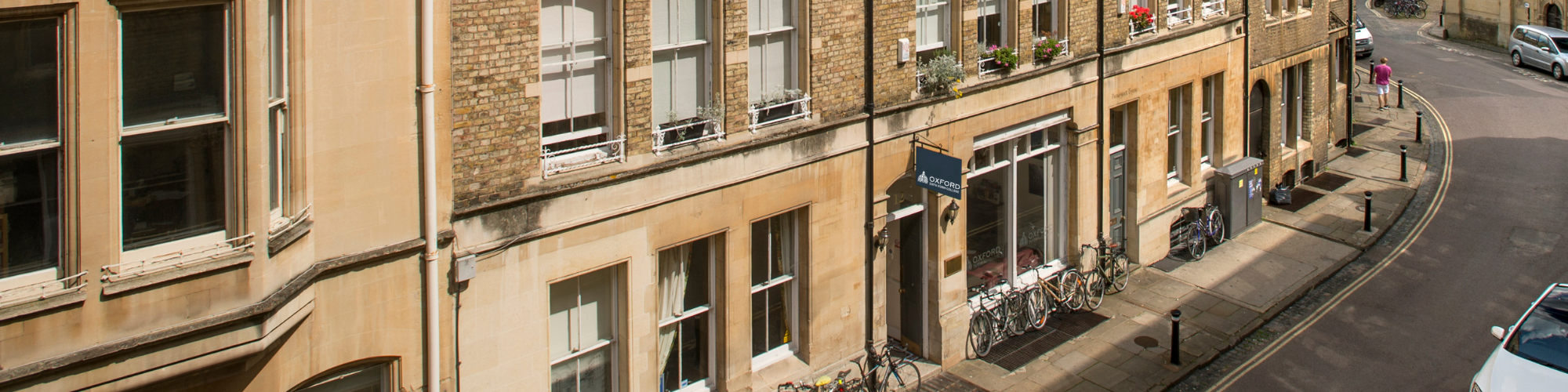
Teaching takes place within the residential campus and there are additional study, IT and library facilities for independent research at the Oxford Tutorial College premises in King Edward Street, a few yards from the famous Oxford High Street and within 200 yards of Radcliffe Square . There is a common room on site for student relaxation and social activity. Wireless internet access is available at both sites.